KNOW YOUR
TRUE STRENGTH LEVEL
The most accurate strength calculator on the web. Calculate your 1 rep max, benchmark your strength level against real-world standards, and discover exactly where you stand with our complete suite of powerlifting, fitness, and body composition tools.
Free Tools
Accuracy
Lifters Helped
Strength Levels
YOUR COMPLETE
STRENGTH TOOLKIT
Every calculator a serious lifter needs — from your one rep max calculator to strength
percentile, RPE, calorie goals, and beyond. All free, all instant.
1RM Calculator
Estimate your one rep max from any set × reps combination using proven formulas.
Bench Press Calculator
Calculate bench press 1RM and see how you compare against strength standards.
Deadlift Calculator
Find your deadlift 1RM and strength level across beginner to elite tiers.
Strength Percentile
Discover what percentile your lifts rank in against real lifters nationwide.
RPE Calculator
Convert RPE ratings to load percentages and plan smarter training blocks.
Powerlifting Calculator
Calculate total, Wilks, DOTS, and IPF points for your powerlifting meets.
TDEE Calculator
Total Daily Energy Expenditure based on your activity level and body stats.
Body Fat % Calculator
Estimate body fat percentage using Navy, Jackson-Pollock, or YMCA methods.
BMI Calculator
Calculate your Body Mass Index and understand what it means for athletes.
Calorie Calculator
Find your ideal calorie intake for cutting, bulking, or body recomposition.
PR Calculator
Project future personal records based on your current training trajectory.
lbs to kg Converter
Instantly convert between pounds and kilograms for any lift or weight.
WHAT IS 1RM AND WHY DOES IT MATTER?
Your one rep max (1RM) is the maximum amount of weight you can lift for a single repetition of any given exercise with proper form. It is the gold standard measurement of raw strength in powerlifting, weightlifting, and strength training.
Knowing your 1RM isn’t just a bragging metric. It is a training tool. Coaches and programs like Juggernaut AI, Westside Barbell, and 5/3/1 all prescribe training loads as a percentage of your 1RM. Without an accurate 1RM, your entire program is built on guesswork.
Our 1RM calculator uses the industry-standard Epley formula — the same method trusted by competitive powerlifters, strength coaches, and programs featured on platforms like Symmetric Strength and StrengthLog — to estimate your maximum from any working set.
Why Not Just Test Your 1RM?
Maximal-effort singles carry injury risk and fatigue cost. Estimating from a 3–5 rep set is safer, more repeatable, and often more accurate for training planning purposes.
Multiple Formulas Supported
Our calculator supports Epley, Brzycki, Lander, Lombardi, and O'Conner formulas — giving you an average and a range so you always have the most accurate estimate possible.
Works for All Lifts
Bench press, deadlift, squat, overhead press, Pendlay row, power clean, Zercher squat, Zottman curl, and Viking press — our calculator handles every movement.
STRENGTH STANDARDS
BY LIFT & LEVEL
as multiples of bodyweight for a 185 lb (84 kg) male.
| Lift | Beginner | Novice | Intermediate | Advanced | Elite |
|---|---|---|---|---|---|
| Bench Press | 0.5× BW | 0.75× BW | 1.25× BW | 1.75× BW | 2.5× BW |
| Squat | 0.75× BW | 1.25× BW | 1.5× BW | 2.25× BW | 3.0× BW |
| Deadlift | 1.0× BW | 1.5× BW | 2.0× BW | 2.5× BW | 3.5× BW |
| Overhead Press | 0.35× BW | 0.55× BW | 0.80× BW | 1.0× BW | 1.3× BW |
| Power Clean | 0.5× BW | 0.75× BW | 1.0× BW | 1.25× BW | 1.5× BW |
| Pendlay Row | 0.5× BW | 0.75× BW | 1.0× BW | 1.5× BW | 2.0× BW |
These are general benchmarks. For precise standards adjusted for your bodyweight, sex, age, and lifting experience, use our dedicated strength percentile calculator.
HOW MUCH SHOULD
YOU BENCH PRESS?
One of the most common questions in the gym: “How much should I be able to bench?” and “Can I bench 225?”
or even “Can I bench 315?”
Benching 135 lbs (1 plate) is the typical beginner milestone, usually achievable within 3–6 months of consistent training for average-sized males.
The 225 lbs (2-plate) bench is a widely recognized intermediate milestone. Most recreational lifters reach this with 1–3 years of dedicated training.
Benching 315 lbs (3 plates) puts you in the top 5–10% of lifters. This is an advanced goal that typically requires 3–5+ years of structured strength training.
Why Can't I Bench Press More?
If you’re struggling to increase your bench press, common limiting factors include insufficient chest, tricep, and front delt volume, poor bar path mechanics, inadequate leg drive, and programming errors.
Our bench press calculator and RPE tool help you identify whether you are training in the right intensity zones.
How to Increase Your Bench Press
Evidence-based strategies for a bigger bench:
- Train bench 2–3x per week with varied rep ranges
- Use our RPE calculator to auto-regulate intensity
- Add paused bench, close-grip, and board presses
- Track calories — a caloric deficit kills strength gains
- Use Versa Gripps or chalk for accessory pulling work
- Calculate your TDEE to ensure adequate protein intake
STRENGTH CALCULATOR:
DEADLIFT STANDARDS
The deadlift is the king of strength exercises. Use our strength calculator deadlift tool
to estimate your 1RM and compare against strength levels.
A 100kg (220 lb) deadlift is a respectable beginner-to-novice milestone for most adult males. For women, it represents an intermediate-level achievement.
Whether your goal is a 1.5× or 2.5× bodyweight deadlift, our calculator maps the path.
The EZ Bar & Bar Weight Question
A question we see constantly: “How much does the bar weigh?” Understanding bar weight is critical when tracking real strength numbers.
Standard Olympic Barbell
45 lbs / 20 kg — the universal baseline used in all strength standards and our strength calculator.
EZ Bar (ExRx Style)
Typically 25–35 lbs depending on the model. Always confirm the weight of your specific EZ bar before logging lifts.
Women's Olympic Bar
33 lbs / 15 kg — used in international competition and accounted for in our female strength standards.
Safety Squat / Specialty Bars
SSB, hex bar, and cambered bars range from 45–75 lbs. Our powerlifting calculator includes specialty bar inputs.
HOW OUR
STRENGTH CALCULATOR WORKS
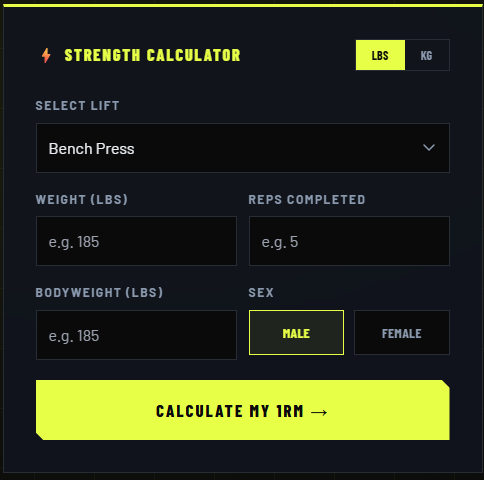
Input the weight lifted and the number of reps completed. This works for any compound or isolation movement.
Choose from Epley, Brzycki, Lander, or let our calculator average multiple formulas for the most reliable 1RM estimate.
Your result is instantly cross-referenced against our database of strength standards by age and weight.
Our strength percentile calculator shows exactly where you rank among real lifters.
STRENGTH CALCULATOR
POWERLIFTING EDITION
Competitive powerlifters need more than a simple 1RM calculator. Our strength calculator powerlifting suite calculates your Wilks coefficient, DOTS score, and IPF GL points.
Whether you’re competing in the USAPL, IPF, RPS, SPF, or USPA, understanding your coefficient score tells you how you compare pound-for-pound.
Training systems like Juggernaut AI and Symmetric Strength use these metrics. Now you can access the same calculations without a subscription.
Our RPE calculator is fully integrated, allowing you to convert your Rate of Perceived Exertion ratings to precise load percentages.
Wilks Calculator
The original bodyweight-normalized scoring system for powerlifting.
DOTS Score Calculator
The modern replacement for Wilks, used by the IPF.
IPF GL Points
The current official IPF scoring system, used at World Championships.
RPE to % Converter
Convert RPE 6–10 to precise percentages of your 1RM.
Meet Total Calculator
Calculate your powerlifting total and project opener selections.
STRENGHOW STRONG
ARE YOU, REALLY?
The Strength Percentile Calculator Explained
Absolute numbers are misleading without context. Our strength percentile calculator accounts for bodyweight, sex, and age to give you a true comparison.
This answers the question “How strong am I?” with precision.
Top 50%
You lift more than half the population.
Top 25%
Intermediate territory. 1–2 years training.
Top 10%
Advanced strength. 3–5 years dedicated.
Top 1%
Near-competitive level strength.
Strength Calculator 5E System
The strength calculator 5e system classifies lifters across five tiers:
0–6 months consistent training
BEYOND STRENGTH
BODY COMPOSITION TOOLS
and body stats to support your strength training goals.
Body Mass Index is a crude but widely-used screening tool. Our BMI calculator gives you your number and explains why it's limited for strength athletes.
Body fat percentage is a far more meaningful metric for lifters than BMI. Our body fat percentage calculator uses multiple validated methods.
Your TDEE calculator establishes your maintenance calories. Combine with our calorie calculator to set accurate targets.
KEY MOVEMENTS IN THE
STRENGTH CALCULATOR
The definitive upper-body strength test. Flat, incline, and close-grip variants supported.
Conventional and sumo variants. Benchmark your pull against elite standards.
The cornerstone of lower body strength training.
An explosive pull from the floor to the front rack.
The strict barbell row variant for pulling strength.
A complete upper-body strength indicator.
A challenging squat variant. Brutal for core and upper back.
Specialty pressing movement for shoulder pressing volume.
A rotating dumbbell curl for biceps and brachioradialis.
From leg press to hack squats — build the legs that support massive lifts.
Variable resistance band training for strength and conditioning.
Our guide explains every level from Trainer to #4.
TRAIN SMARTER WITH THE
RIGHT RESOURCES
training with.
Finding the Right Gym
Whether you train at Planet Fitness, LA Fitness, Lifetime Fitness, or a dedicated powerlifting gym, understanding the equipment available helps you use our calculators accurately.
Our lbs to kg converter and bar weight reference guide ensure your calculations are always based on your actual lifted load.
Using our strength standards by age and weight tool before joining a gym gives you realistic short-term targets.
Gear That Affects Your Numbers
Versa Gripps
Wrist straps and grip aids can increase your pulling capacity significantly. Raw strength standards assume no straps.
Lifting Belts
A proper powerlifting belt can add 5–15% to your squat and deadlift.
FUEL YOUR STRENGTH:
NUTRITION CALCULATORS
What Are Peptides and How Do They Relate to Strength?
Peptides are short chains of amino acids that occur naturally in the body. We recommend always consulting a licensed medical professional before using any supplement or performance-enhancing compound.
How to Lose Weight Without Losing Strength
Aggressive caloric deficits reliably decrease strength. Use our TDEE calculator and calorie calculator to create a controlled deficit that preserves muscle mass.
Key Nutrition Tools
TDEE Calculator
Calculates Total Daily Energy Expenditure based on BMR × activity multiplier.
Calorie Calculator
Set calorie goals for cutting, bulking, or recomposition based on your TDEE.
Macro Calculator
Distribute your calories into optimal protein, carbohydrate, and fat ratios.
Body Fat % Calculator
Track body composition changes alongside your strength metrics.
THE MOST ACCURATE
STRENGTH CALCULATOR AVAILABLE
We built this platform for serious lifters who need reliable data, not guesswork.
Multiple Validated Formulas
We don't rely on a single formula. Our 1RM calculator uses Epley, Brzycki, Lander, O'Conner, and Lombardi, then provides a weighted average.
Real-World Data
Strength percentile data is sourced from competitive meet databases and gym population studies.
Always Updated
Strength standards evolve as the sporting population grows. Our data is reviewed and updated regularly.
FREQUENTLY ASKED
QUESTIONS
Every question a lifter has about strength calculators, 1RM, standards, and
programming — answered clearly.
What is a 1RM calculator?
How much should I be able to bench press?
The answer depends on your bodyweight, sex, age, and training history. A general benchmark for untrained adult males: benching your bodyweight once is a solid novice goal. Intermediate lifters typically bench 1.25–1.5× bodyweight.
Can I bench 315 lbs?
A 315 lb bench press (3 plates per side) is an advanced milestone placing you in approximately the top 5–10% of lifters. Most people who reach this mark have 3–5+ years of dedicated training.
What is RPE in strength training?
RPE (Rate of Perceived Exertion) is a 1–10 scale for rting how hard a set feels. RPE 10 means maximum effort, RPE 9 means 1 rep left, RPE 8 means 2 reps left, and so on.
How much does the bar weigh?
What is a Pendlay row?
A Pendlay row is a strict variation of the barbell row where each rep begins with the bar resting on the floor. The torso stays parallel to the floor.
What is a power clean and how is it measured?
A power clean is an explosive barbell lift from the floor to the front rack position. A 1× bodyweight power clean is generally considered intermediate.
What is the difference between 1RM and strength level?
Your 1RM is an absolute number. Your strength level is where that number places you relative to other lifters of your bodyweight, sex, and age.
How accurate is a 1RM calculator?
When used with sets of 3–6 reps, a 1RM calculator is typically accurate within 2–5% of your true maximum. Accuracy decreases for sets above 10 reps. Our calculator averages five formulas for the most reliable estimate.
Can I bench 225 lbs?
Yes — with consistent training, most adult males can reach a 225 lb bench press. The average timeline is 1–3 years of regular strength training.
Is a 100kg deadlift good?
A 100kg (220 lb) deadlift is a good beginner-to-novice achievement for an adult male. For women, 100kg is an intermediate-to-advanced achievement.
What is Symmetric Strength?
Symmetric Strength is a popular online strength standards and percentile platform. Our platform covers similar functionality and is fully free without a signup requirement.
What are strength standards by age and weight?
Strength standards by age and weight are benchmarks that define what constitutes beginner through elite strength for your specific demographic.
Which Captain of Crush gripper should I start with?
If you have no dedicated grip training background, start with the Trainer (100 lb) or No. 1 (140 lb) gripper.
Why can't I bench press? (Common reasons)
FIND OUT HOW
STRONG YOU ARE
in under 10 seconds. No account. No nonsense.